Amanda Yip
Art isn’t Always Accessible. I Want to Change That.
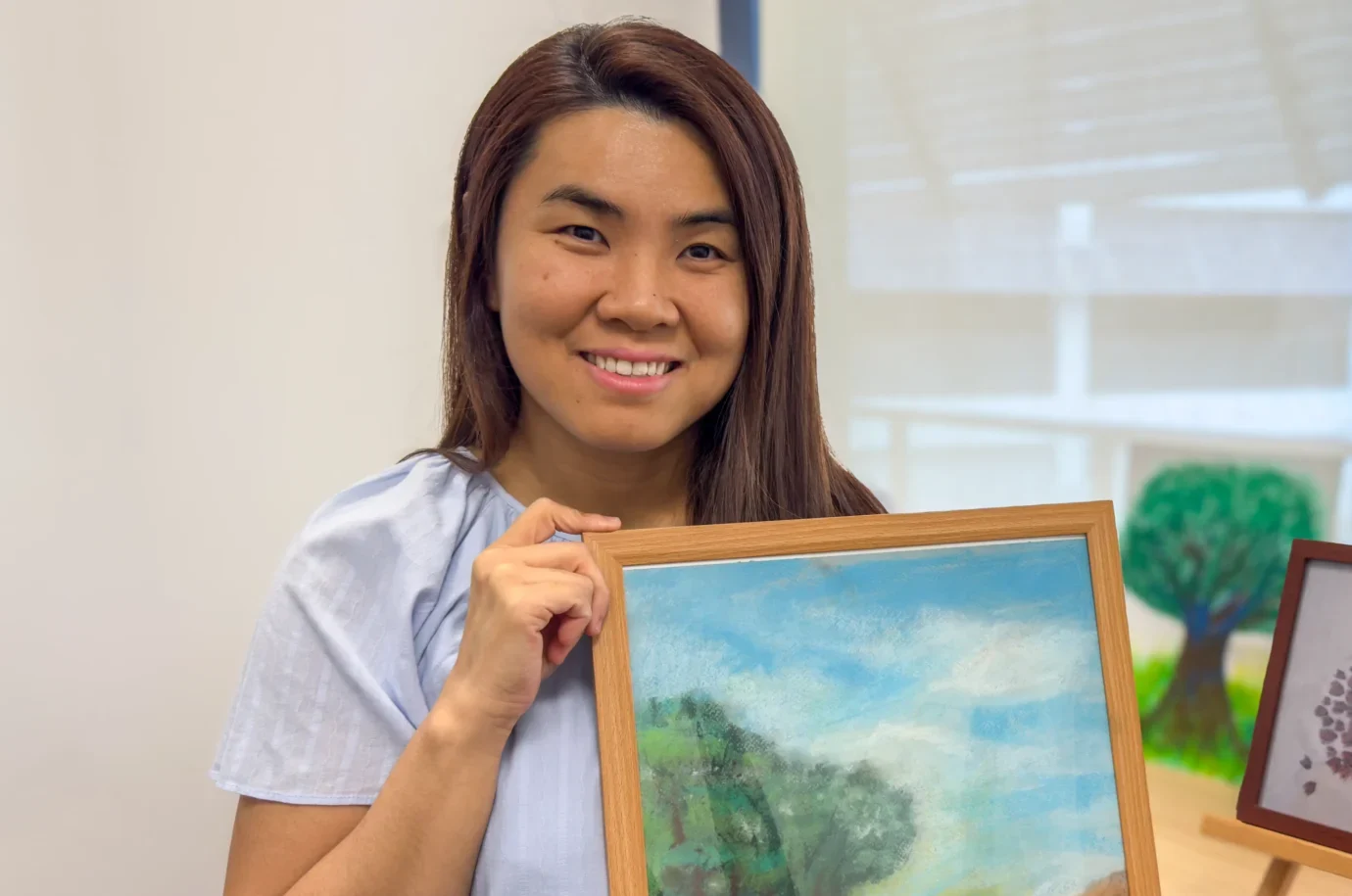
Amanda Yip is the Lead Artist and Co-founder of Rebirth Ensemble, an arts and accessibility studio. She is also a person with vision impairment.
What is your journey with art like?
When I was younger, I found great joy in drawing, creating, and expressing myself through art.
But when my vision started severely declining in my late teens, I just stopped engaging with it. I didn’t think about how it would be possible anymore.
Things began to change when I met my partner Shalom. He and I both share a deep love for art, and we truly re-kindled our passion together. At this point in my life, I also knew better – throughout history, there have been people all over the world who did not let their vision impairment stop them from creating art, including sculptures, painters, and even photographers.
My eye condition means I can still see blurry shapes, but I can’t differentiate between some shades of colours. To be very honest, I really miss that. I also didn’t have much formal art training until I went to get lessons from a mentor of Shalom’s. I’m always learning as I go.
With patience, trial and error, and now having Shalom to act as my eyes, I can start creating things again.
What themes do you want to explore with your art?
The concept of rebirth is one that resonates with both Shalom and me. In a very real way, our venture into art is our second chance at life. It’s a new beginning for both of us. And as corny as it sounds, it’s what we both have always dreamed of doing.
The first major project we’re embarking on together involves re-imagining some paintings done by Shalom with his late brother, Isaac. Titled “Kindred Spirit”, it’ll be both in remembrance of a loved one lost, and also giving the piece new life, new meaning.
Right now, our goal for our studio is to make our art accessible to all. No matter who you are, even if you’re a person with a disability (and yes, even if you’re vision impaired), you will be able to enjoy our pieces, “as the artist intended”.
How do you make art accessible for persons with vision impairment?
Right now, the most common way visual art pieces like photographs and paintings are made accessible is through tactile paper. This involves using specialised paper that is heated by a machine to emboss lines that can be felt. It is a method adopted by many museums that are exploring ways to make visual materials accessible for visitors with vision impairments.
The thing is, this technology is really useful in places like the classroom, where you’re often trying to depict and interpret simple diagrams. It’s perfectly serviceable when you’re embossing, let’s say, a few atoms on the paper for a student learning chemistry.
However, when applied to more visually complex works, like a painting or a photograph, the experience can become challenging. To actually interpret what the lines, criss-crosses, and textures mean, you literally need a separate, physical tactile dictionary where there’s descriptions of what each texture is supposed to represent.
To be direct, it’s actually quite a mentally exhausting experience. I’d rather skip an exhibit than subject myself to over an hour touching a tactile paper diagram (which is often how long it takes to actually understand what a complex visual looks like using this method).
Personally, I feel that exhibits like the Touch Collection at Singapore Art Museum offer a more engaging approach. where many art pieces are transformed, or re-interpreted into 3-dimensional forms that are designed to be touched by visitors with vision impairments.
This is how Shalom and I are planning to launch our first series of fully accessible artworks. Truly tactile art that can be both viewed with your eyes and touched by hand to appreciate. It leaves no one behind, and creates a truly inclusive experience.
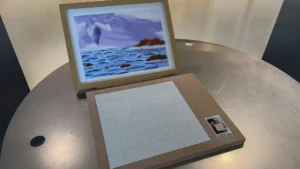
‘Serenity’, one of Amanda’s artworks that has been adapted into an accessible tactile art piece and wooden puzzle set. It is currently being displayed at the Enabling Village.
What motivated you to set up your art studio as a business?
Employment can present unique considerations for persons with disabilities. For individuals with visual impairments like myself, this can be more pronounced, as many workplace processes are designed with visual interaction in mind.
There are times when colleagues or managers may need to share information visually, and this can require some adjustments on both sides. While I do my best to work with others and explore ways to adapt, I’ve come to understand that different environments and individuals vary in how they approach these situations.
Although I was consistently able to find employment, there was often a sense of uncertainty about long-term stability. Like many others, I was mindful of how workplaces evolve over time and the broader considerations around experience, pace, and cost.
After about 10 years, I began reflecting more deeply on what I wanted for myself, and realised that I was ready to explore paths that might better align with how I hoped to grow and find fulfilment.
So when the opportunity came to explore art with someone who shares similar values, artistic vision, and passion as me, I eventually decided, “Why not?”
At the outset, starting a business did not seem like an obvious or easy option. However, through conversations with friends in the disability sector, we discovered a growing community of practitioners in the accessible arts space, including in places such as the United Kingdom and Hong Kong. Knowing that such work was already taking place elsewhere provided a sense of encouragement. Over time, the idea of establishing a social enterprise in this space began to feel both viable and purposeful.
Ultimately, what matters most to Shalom and me is that we are pursuing something we deeply care about. While the future remains uncertain, we are committed to the journey and grateful for the opportunity to do this work.
What is your work process like when you are vision impaired?
I still have some remaining vision, so I use a combination of whatever I can see alongside assistive technologies.
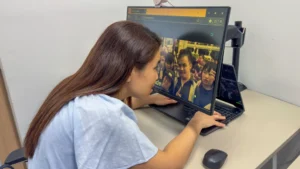
But when I need to type or read a large chunk of text on my computer and phone, I use a screen reader – it’s a talking software that reads what’s on the screen.
View this post on Instagram
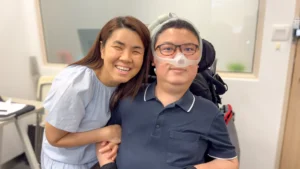
When it comes to the art creation process, sometimes I use what I can see. And of course, I can rely on Shalom to help me spot things or give direction. In a very real way, he is my eyes. And given his physical disability, I can be his hands and legs.
What is your biggest hope for the future?
Right now, we’re focusing on building our business and finding our footing in the art world. It has been a daunting journey as first-time business owners, but we have been fortunate to receive strong support from friends, family, and mentors, and I’m very grateful.
In the longer term, my true ambition is to explore all the ways we can open doors of opportunities for artists in the disability space.Too often, work by persons with disabilities is framed in a way that centres sympathy. I hope to see a shift towards recognising artists for the value and quality of their contributions, beyond their disabilities.
With Rebirth Ensemble, our aspiration is to grow into a platform that can support and uplift others in the disability community over time.