Amanda Nicole Chan
How I Built My Dream Wheelchair-Friendly Home
First things first: how do you enter your home using your wheelchair?
Most public housing apartments require you to step up into the home to enter. And my block is an older estate, so it wasn’t exactly built with accessibility in mind.
The simple answer is: we build a ramp!
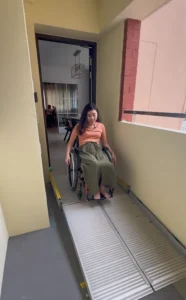
The installation of the ramp was supported by the Housing Development Board (HDB), through the Enhancement for Active Seniors (EASE) programme. I’m obviously not a senior yet but wheelchair users like me do take advantage of many of the same government-funded programmes seniors get for home enhancements that increase safety and mobility.
At first, HDB gave me the option for their default ramp. But it was too steep if I wanted to be able to enter the house on my own, without anyone having to come and push me in. So I asked them if there was any possible way we could explore an alternative.
After some discussions, we managed to get approval for a longer metal ramp with a gentler slope. Their only requirement was that the access door for maintenance workers must be accessible upon request, as our ramp does block the door when fully extended. When the maintenance workers from town council come down to our place, we simply fold up the ramp to clear the space for them.
The funding from the HDB EASE programme also offset the cost greatly. The total cost for the installation was about $1,000. But after the funding subsidies, I paid a grand total of about $200 for my ramp. Not bad at all, if I could say so myself.
The moral of the story: always negotiate, and don’t just settle for the first option given to you if it doesn’t fully meet your needs. As a wheelchair user, I had some requirements in mind for my home, including my desire to be able to enter and exit independently. We just need to be nice about it when we’re asking for help.
What’s your favourite feature in the house?
The kitchen. This was a very important part of our home when we were planning and renovating our place.
Because of the layout of our unit, the kitchen is basically in view from almost every part of the home. So it was very important for me personally to ensure that it looked great.
The kitchen ended up being a sort of centrepiece for the overall aesthetic theme we had for the place. Any guesses on what that theme is?
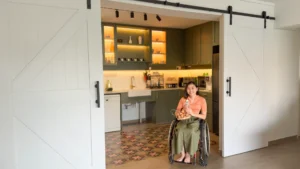
It’s a modern farmhouse! These barn doors are one of my personal favourite pieces in the house.
Could you give us a quick house tour?
The living room is deliberately quite sparse, so I can navigate using my wheelchair.
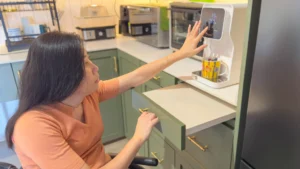
You’ve already seen a bit of my kitchen. But one feature I love are these pull-out drawers.
When I want to get a drink, I can just pull out a drawer, put my cup on, do what I need to do, and push the drawer back in once I’m done. It’s both tidy and functional for my needs.
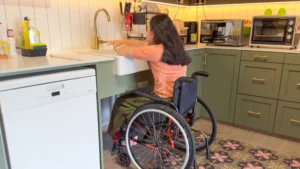
Many homes have sinks which have storage compartments below the basin. But this doesn’t work for me because there’s no space for my wheelchair if there’s a cabinet right below the sink.
This is a deliberate choice we had to make when renovating our home. I’m very glad I don’t have to get my toes crushed anymore when I just want to wash my hands.
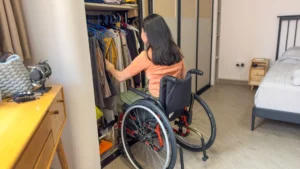
My wardrobe has a similar function in its design and layout. I can push my wheelchair right up to it, without my legs getting in the way.
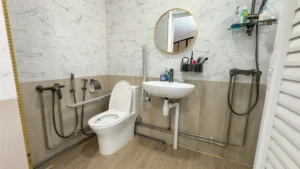
Our bathroom is a major game-changer. When I lived with my parents, the bathroom situation really wasn’t ideal. Even after modifications, the shower head was still out of reach for me. Now, I had the chance to fix all of this.
Not only is everything at an appropriate height for a wheelchair user, I also had the opportunity to pick out anti-slip grab bars with the right texture that I can get a secure grip onto, even when they are wet.
It sounds really simple. But it’s these simple things that allow me to use the bathroom whenever I want to, and not having to worry about getting help.
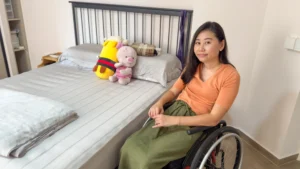
The place where I end every day. The choice of bed frame was really important because it’s very common for the frames to be too tall for me to get into bed easily.
I ended up doing a lot of research on Taobao (yes, really) to find a suitable model. The one I wanted ended up being slightly too tall by default, so I messaged the seller asking them if they had any other options to customise the height of the bed frame, like having shorter legs. After explaining my situation to them, we managed to make it work. As the saying goes, ask and you shall receive.
What was the home renovation process like?
From the point where we started looking for a place, to the completion of all the renovations, it all took 2 years. It was incredibly fast, actually. I do feel very grateful that everything went so smoothly, for the most part.
We did run into some obstacles at first though. There were many homes which we really liked, but couldn’t go with for one reason or another.
For example, we wanted a resale unit because the home interiors are physically bigger, which means more space to navigate with a wheelchair. But older resale units, unlike newer Build-to-Order (BTO) flats, were often not built with wheelchair accessibility in mind back in those days, which means that I could not get a unit along the length of a corridor because the pathways were simply too narrow to accommodate a gentle slope ramp to enter my home. This meant that if we wanted a resale unit for the benefits of having a larger home interior, our only option was to find a corner unit that had enough clearance at the entrance to accommodate the kind of ramp I wanted. And corner units, as many home buyers would know, are always in high demand and short supply.
The bathroom also ended up posing some challenges. Many apartments just ended up having bathrooms which were too small, or positioned with the entrances at awkward angles that would make it challenging to enter using my wheelchair.
It took somewhere between 3 to 4 months to finally find the right place. It was pretty disheartening whenever we would visit a home we liked, only to find it would not work. But all that effort was totally worth it in the end
When it came to the actual renovations, I do have to say that it was a major team effort. My husband Qing Rui did most of the logistics, coordinating with our interior designer. I came up with the ideas and made many of the design choices. A lot of the work actually comes down to clearly communicating what we wanted to each other and to our interior designer, so they could do their magic.
What is one major lesson you learned from this experience?
It takes a surprising amount of effort to be specific about what you want. If I could give a piece of advice to anyone, disabled or not, who is embarking on a home renovation project, I’ll strongly advise taking the time to describe your dreams and ideas in concrete terms.
If you want a “warm vibe” in the home, what exact shade of light brown do you actually want the walls to be? If you want the furniture to be “wheelchair-accessible”, what is the exact height everything needs to be for your body height and wheelchair?
My husband and I were both pretty clear on what we wanted from our home. While a lot of my desires were focused on the aesthetics and accessibility of the home, my husband’s requirements, perhaps quite predictably, were focused on the tech. Some of the things he wanted included a gaming corner, and space in the living room large enough for a 65-inch TV. Something we both wanted was a kitchen with space that would be conducive to prepare home-cooked meals.
In my opinion, being specific not only helps everyone get a better understanding of what’s the right thing to do, it also helps you figure out if something you think you want will actually make you happy.
Tell us a bit more about yourself?
I’m not sure I’m the most interesting person, and I don’t usually like talking about myself. I have my family. I go to work at my job. I try to live my life on my own terms and stay in touch with the people I love.
I’m a member of the Para Cycling Federation of Singapore, which is an organisation dedicated to promoting para cycling for persons with disabilities. I used to cycle using a hand bike up till recently, and it was a great way to stay active and socialise with my fellow cyclists. I’m still a part of the committee, taking charge of Outreach matters.
I lost the use of my lower body in my twenties due to a spinal condition. Today, I personally use a manual wheelchair instead of an electronic personal mobility device (PMD) because I like the exercise.
Being as independent as I can be is very important to me. I think it gives me a sense of dignity, to remind myself that I’m still capable despite my physical limitations. That’s why so many features in my home are designed to enable me to do things myself.
A Goh Chok Tong Enable Awardee
Fun fact: Amanda may be a bit too humble to brag about it on her own, but she is also notably a recipient of the 2025 Goh Chok Tong Enable Award. She was conferred the award by Emeritus Senior Minister Goh Chok Tong in recognition of her contributions to inclusive sports with the Para Cycling Federation of Singapore, being a founding member of the dbEnable Cycling for All initiative at her workplace, Deutsche Bank. Amanda also mentors interns with disabilities under the dbEnable internship programme. Go Amanda!
How did it make you feel to see your “dream home” fully completed?
10 years ago, I would not have even dreamed about having the opportunity to build my very own home in this way. I do feel a real sense of accomplishment for what my husband and I have been able to do here. Along with help from our interior designer and HDB of course.
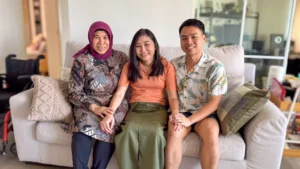
I’m not fully physically independent. I still rely on my caregiver and husband for some tasks. But having designed my home to ensure I have the maximum amount of autonomy possible gives me a gratifying feeling that is difficult to explain.
I feel very proud. And very blessed for what I have.